Solitaire on a short break: does it help, and which game fits?
Brain and wellbeing
Almost half of all solitaire on Solitaire Land is played on weekdays between 9:00 and 17:00. Studies of short breaks find that a few minutes away from work leave people with a little more energy and a little less tiredness. Here is what they found, how long a solitaire break really lasts, and which games fit in five minutes.
Solitaire and the office have gone together since Windows 3.0 put a deck of cards on office screens in 1990. A quick game between two tasks is one of the oldest habits of working life with a computer. We wanted to know whether that is still how people play, and whether a short break like that does any good.
So we looked at a year of games on Solitaire Land, 6,777,430 of them, to see when people play and for how long. And we read the research on short breaks, including one study that put a casual game to the test.
Solitaire is a weekday game
We took the hour each game started, in the player's own local time, and counted every player the same, however much they play. Weekdays from 9:00 to 17:00 are less than a quarter of the week's hours. They hold almost half of all the play:
- Share of the week's hours
- Share of the play
In numbers: 78% of the play falls on Monday to Friday, which are 71% of the days. An ordinary weekday sees about 44% more solitaire than a Saturday or a Sunday. And 46% of it is played in working hours, which take up only 24% of the week.
The shape of a weekday looks like a working day too. Play climbs through the morning to a first peak at 11:00, dips over lunch, then rises to its highest point between 15:00 and 17:00. After work it falls away, and by 20:00 people play no more per hour than they do at the weekend.
| Part of the week | Share of the week's hours | Share of the play |
|---|---|---|
| Weekdays, 0:00 to 9:00 | 27% | 9% |
| Weekdays, 9:00 to 17:00 | 24% | 46% |
| Weekdays, 17:00 to 24:00 | 21% | 24% |
| Saturday and Sunday | 29% | 22% |
This is not one country's habit. In each of the 14 countries with at least 1,000 players in our data, most of the play falls on weekdays, from 73% to 87% of it. We can't see where anyone is sitting, and many players are students, retired or at home. But the pattern is the pattern of a working day, and a game of solitaire seems to be how many people take their breaks.
What the research says about short breaks
The best summary of the evidence is a review of 22 studies with 2,335 people, by psychologists at the West University of Timișoara in Romania (Albulescu and colleagues, 2022). They looked at "micro-breaks": pauses of no more than 10 minutes during a task, from watching a short video to stretching or a relaxation exercise.
After a micro-break, people felt more energetic and less tired. Both effects were small but clear (an effect size of about a third of a standard deviation), and they held across the studies, however long the break was and whoever took it. The authors' conclusion: breaks of close to ten minutes help against tiredness.
Work after the break was another matter. Overall, people did not do measurably better. They did better on routine tasks and on creative ones, but not after demanding mental work, and the longer the break, the more it helped. For really tiring work, the authors write, people "may need more than 10-minute breaks". As for what to do in the break, the studies were too varied to say which activity works best. For feeling better, the answer "seems to be any type of decoupling activity": anything that takes your mind off the work.
What it can't prove: the studies were small, about half of them were done with students, and only four of the 22 were judged at low risk of bias. Energy and tiredness were what people said they felt, not something measured. And no study in the review tested a card game.
One study did test a casual game. At the University of Central Florida, 66 people first did a dull computer task built to tire them out, then had a 5-minute break (Rupp and colleagues, 2017). Each was given one of three breaks at random: playing a simple game called Sushi Cat, a guided relaxation exercise, or sitting quietly with no phone or computer.
Only the game players said they felt better after the break. They were also more engaged than the relaxation group. Sitting quietly did the least good: those people felt a little worse and less engaged than before. But none of the three breaks brought back performance on the memory test that followed.
What it can't prove: 66 people, one game, one session in a lab. It wasn't solitaire, and it measured mood, not health. It does fit what other research has found about games and mood: in the studies we described in our post on solitaire and the brain, what mattered most was enjoying the game, not how long people played (Vuorre and colleagues, 2022).
Which games fit in five minutes?
If a break is a few minutes, the game should be too. For each game we counted how many wins took less than five minutes and less than ten. The table is sorted by the typical (median) winning time, shortest first:
| Game | Typical winning time | Wins under 5 minutes | Wins under 10 minutes |
|---|---|---|---|
| Bipeaks Solitaire | 1:03 | 99% | 99% |
| Weave Solitaire | 1:07 | 99% | 99% |
| Diamond Solitaire | 1:09 | 99% | 99% |
| Suspension Solitaire | 1:10 | 99% | 99% |
| Bunches Solitaire | 1:13 | 99% | 99% |
| Reverse Tripeaks Solitaire | 1:13 | 98% | 99% |
| Tripeaks Solitaire | 1:14 | 98% | 99% |
| Five Bridges Solitaire | 1:18 | 98% | 99% |
| Fourpeaks Solitaire | 1:20 | 99% | 99% |
| Hole In One Solitaire | 1:28 | 98% | 99% |
| Alaska Solitaire | 2:45 | 86% | 95% |
| Russian Solitaire | 2:58 | 85% | 98% |
| Klondike Solitaire 3 Cards | 3:08 | 87% | 98% |
| FreeCell Solitaire | 3:11 | 78% | 95% |
| Klondike Solitaire 1 Card | 3:16 | 83% | 97% |
| Wasp II Solitaire | 3:18 | 86% | 98% |
| Scorpion Solitaire | 3:19 | 82% | 97% |
| Yukon Solitaire | 3:48 | 77% | 97% |
| Wasp Solitaire | 5:26 | 41% | 89% |
| Spider Solitaire 1 Suit | 5:57 | 32% | 87% |
| Spider Solitaire 2 Suits | 8:38 | 5% | 63% |
| Spider Solitaire 4 Suits | 16:35 | 0.1% | 7% |
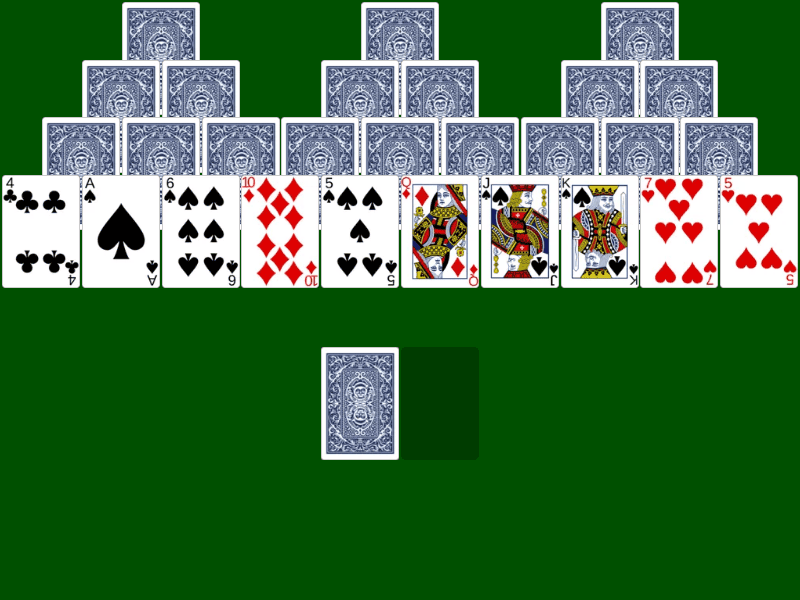
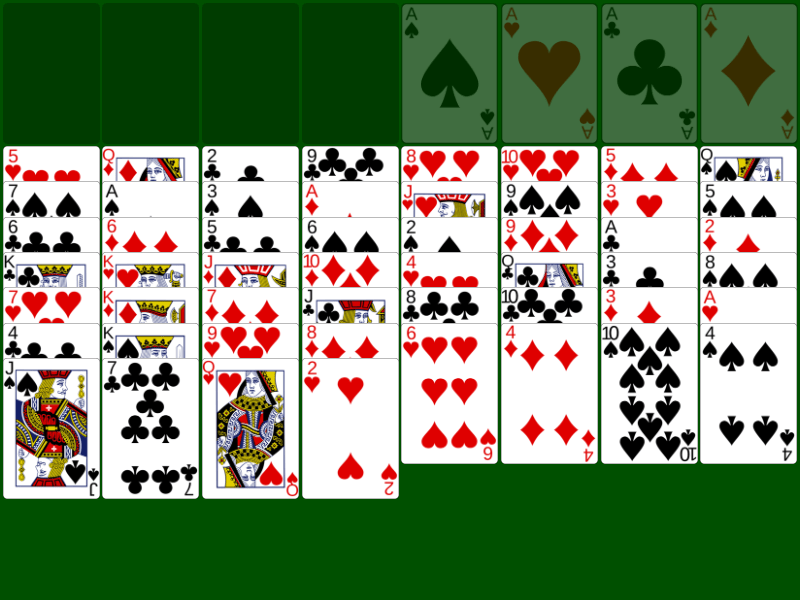
The Tripeaks family is made for a short break: a typical Tripeaks Solitaire win takes 1:14, and 98% of wins are done inside five minutes. The classics fit too: 83% of Klondike Solitaire 1 Card wins and 78% of FreeCell Solitaire wins take under five minutes, and nearly all under ten. Spider is the game to save for later. Only 5% of two-suit Spider Solitaire 2 Suits wins take less than five minutes, and with four suits, only 7% take less than ten. Our post on game times has good and great times for every game.
One game, or four?
A break that is meant to last five minutes doesn't always. We grouped each player's games into sittings: games with no more than 15 minutes between one and the next. The typical sitting is 4 games and 21 minutes. A quarter of them last 9 minutes or less, and a quarter go on for 45 minutes or more. Only 23% are a single game.
Sittings in working hours are hardly shorter than the rest (21 minutes against 22). So a typical solitaire break is about twice as long as the breaks in the review. That is not a crime: the review found that longer breaks help work more. But if what you want is a quick reset, it helps to decide before you start.
How to make a game of solitaire a good break
- Pick a game that fits. For a five-minute break, Tripeaks or one of its family (about a minute a game), or FreeCell or Klondike (about three). Keep Spider for when you have a quarter of an hour.
- Decide how many games before you start. One or two is a break; a dozen is a different afternoon. The Daily challenge is a natural single game: one deal a day, the same for everyone.
- Play because you enjoy it. In the studies, the good effects came with enjoyment. If a game has become something you feel you have to do, a walk is a better break.
- Don't chase the clock. A break is not a race. Use Undo freely, and let a lost game go: some deals can't be won at all.
- Get up afterwards. Six of the studies in the review used breaks on your feet, such as stretching, and for feeling better the authors concluded that anything that takes your mind off work seems to do. A game and then a minute away from the screen is a good pair.
- After hard work, take longer. The review found that demanding mental work needs more than a ten-minute pause before people work better again.
How we measured
- Every game finished on Solitaire Land in the twelve months from 16 November 2025 to 15 November 2026: 6,777,430 games, taken from our database on 15 November 2026. A game counts once a move has been made, and when it ends: won, given up or stuck.
- When people play: the time each game started, in the player's local time. We can only tell that time in countries with a single clock, so the United States, Canada, Brazil, Russia, Australia, Mexico, Indonesia and other countries with several time zones are left out. That leaves 6,232,597 games (92%) by 50,891 players. A player is one browser or device, and each counts the same: we took each player's share of their own games in each hour, then the average over all players. The weekend is Saturday and Sunday; in Saudi Arabia and Israel, where it falls on Friday and Saturday, the weekday share is less exact, and those two countries are left out of the range by country.
- Sittings: a player's games with no more than 15 minutes between the end of one and the start of the next, from the start of the first to the end of the last. 864,423 sittings in the same countries. Games of an hour or more are left out: they are games left open, not played.
- Games under 5 and 10 minutes: the game's own clock, which starts at the first move. Each player counts with at most their latest 100 wins of a game, so a few very keen players can't set the numbers for everyone. Only games with at least 100 players who won and 500 counted wins are in the table: 22 games.
What this doesn't mean
- It doesn't mean everyone who plays on a weekday is at work. Students, retired people and people working from home play then too. The working-day shape is clear; who exactly is behind it, we can't see.
- It doesn't mean solitaire makes you work better. The review found more energy and less tiredness after short breaks, but no clear gain in work overall, and it didn't test card games.
- It doesn't mean more is better. The good effects in these studies came from short breaks and from enjoying the game, not from playing longer.
- It doesn't replace real rest. Sleep, movement and time away from screens matter more than any game.
In short
- Solitaire is a weekday game: 46% of the play on Solitaire Land falls on weekdays between 9:00 and 17:00, only 24% of the week's hours.
- Short breaks help a little: in a review of 22 studies, breaks of up to ten minutes left people with more energy and less tiredness. Their work wasn't clearly better, except on routine and creative tasks.
- In a small lab study, only the people who played a casual game said they felt better after a 5-minute break; sitting quietly did not help.
- For a five-minute break: Tripeaks and its family, or FreeCell and Klondike. Not Spider.
- The typical sitting is 4 games and 21 minutes. If you want a short break, decide on one or two games before you start.
So the next time you open a game between two tasks, you are in good company, and probably on firmer ground than you thought. Pick a short one, enjoy it, and then get up and stretch.
Sources
- Albulescu P, Macsinga I, Rusu A, Sulea C, Bodnaru A, Tulbure BT (2022). "Give me a break!" A systematic review and meta-analysis on the efficacy of micro-breaks for increasing well-being and performance. PLOS ONE 17(8):e0272460. doi:10.1371/journal.pone.0272460
- Rupp MA, Sweetman R, Sosa AE, Smither JA, McConnell DS (2017). Searching for affective and cognitive restoration: examining the restorative effects of casual video game play. Human Factors 59(7):1096–1107. doi:10.1177/0018720817715360
- Vuorre M, Johannes N, Magnusson K, Przybylski AK (2022). Time spent playing video games is unlikely to impact well-being. Royal Society Open Science 9:220411. doi:10.1098/rsos.220411