Spider Solitaire with 1, 2 or 4 suits: how much harder is each?
Strategy
The rules are the same, only the number of suits changes. Yet the typical player wins 84.0% of their one-suit Spider games, 35.1% with two suits and 11.2% with four. We looked at 4,070,596 games to see why, how fast players improve, and when to move up.
Spider is one of the most played games on Solitaire Land, and it comes with a question most games don't ask: how many suits? The choice goes back to Microsoft's Spider Solitaire (first in the Plus! 98 pack, then in Windows Me and XP), which offered three levels: Easy with one suit, Medium with two and Difficult with four. The original game, known since at least 1949, uses all four.
We counted every Spider game finished here since April 2024, 4,070,596 in all. Spider Solitaire 2 Suits is the most played (47% of the games), then Spider Solitaire 4 Suits (32%) and Spider Solitaire 1 Suit (21%). Here is what the numbers say about each one.
1, 2 and 4 suits at a glance
The win rate counts all games together. The typical player is the median win rate of the players with at least 20 games of that version: half of them win more, half win less. Times and moves are the medians of won games.
| Game | Games played | Win rate | Typical player | Typical winning time | Typical winning moves |
|---|---|---|---|---|---|
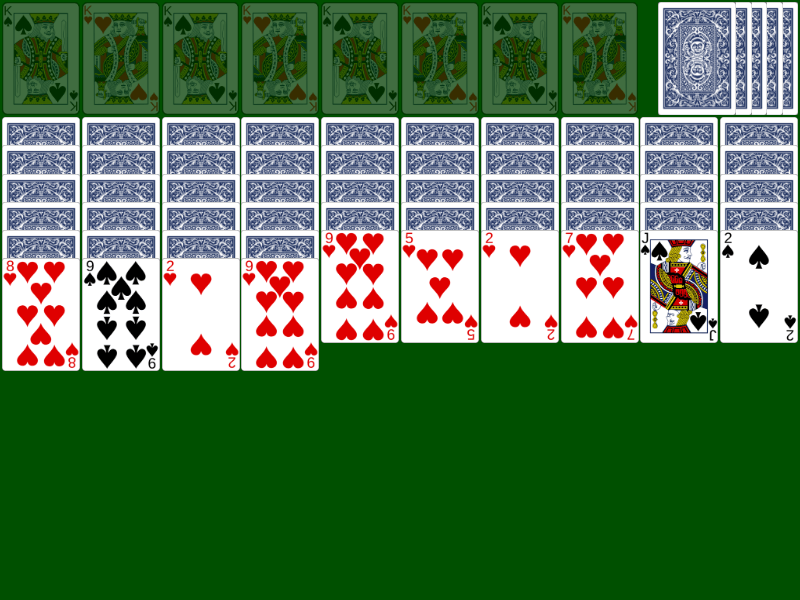
| Spider Solitaire 1 Suit | 866,307 | 79.6% | 84.0% | 5:01 | 128 |
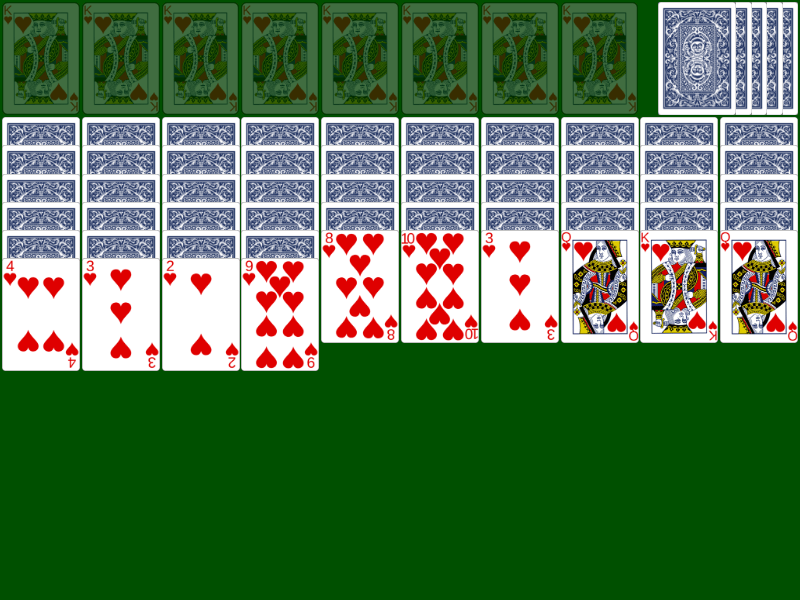
| Spider Solitaire 2 Suits | 1,898,375 | 37.1% | 35.1% | 8:05 | 167 |
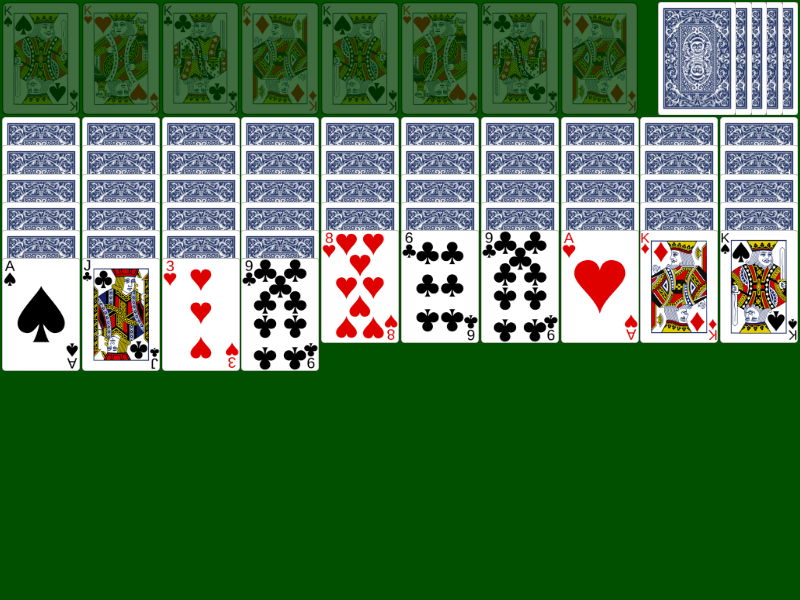
| Spider Solitaire 4 Suits | 1,305,914 | 18.4% | 11.2% | 16:08 | 309 |
Every suit you add cuts the typical player's win rate by more than half. A four-suit win also takes about 3.2 times as long as a one-suit win, and about 2.4 times as many moves. Lost games end much sooner: the typical lost four-suit game is over after 4:58, while the typical win takes 16:08.
Why one more suit changes so much
In every version, any card can go on a card one rank higher, whatever its suit. But only a run of one suit can be moved as a group, and only a full King-to-Ace run of one suit leaves the table. So the question every time you place a card is: does it match?
The deck answers that for you. Spider uses 104 cards, so there are 8 cards of every rank. With one suit, all 8 match: every card you place builds a real run. With two suits, 4 of the 8 match, so 50% of the time. With four suits, only 2 of the 8 match: 25%. Three times out of four, a four-suit card you place breaks a run into pieces that can only move one card at a time.
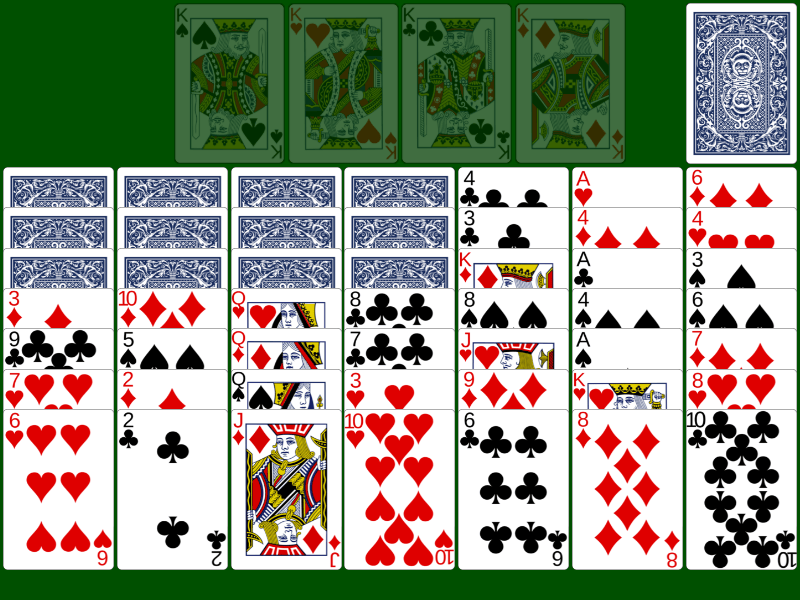
That's why one-suit Spider is mostly about turning cards over, two-suit Spider is about choosing which cards to keep together, and four-suit Spider is about untangling. The empty columns, which let you take a mixed column apart, matter more with every suit you add.
Can every deal be won?
Very nearly, in all three. Of the random deals that were played at least five times on Solitaire Land, players won 99.9% at least once with one suit, 97.7% with two and 95.0% with four. Those are lower limits: a deal that nobody has won yet may still have a way through.
So a lost Spider game is almost never the deal's fault. Last week we compared the same players on random deals and on deals known to be winnable: with two and four suits it made no difference. With four suits the way through is just much harder to find.
How fast do players get better?
We took the players who have played at least 100 games of a version and looked at their win rate game by game: in their first 10 games, in games 11 to 25, and so on. Each line below is the typical (median) player of that group.
- First 10 games
- Games 101 to 250
Players do get better, but slowly. With one suit there is little room left: the typical regular wins 80.0% of their first 10 games and 84.0% later on. With two suits they go from 30.0% to 37.3%, and with four from 10.0% to 14.7%: from one game in ten to about one in seven.
| Game | Games 1–10 | 11–25 | 26–50 | 51–100 | 101–250 |
|---|---|---|---|---|---|
| Spider Solitaire 1 Suit | 80.0% | 80.0% | 84.0% | 82.0% | 84.0% |
| Spider Solitaire 2 Suits | 30.0% | 33.3% | 36.0% | 38.0% | 37.3% |
| Spider Solitaire 4 Suits | 10.0% | 13.3% | 12.0% | 14.0% | 14.7% |
Most of the gain comes in the first fifty games, once the basic habits are in place. With four suits it goes on for longer: the regulars who reach game 251 win 16.4% of their games 251 to 500.
Which one should you play?
Most players never switch. Of the 14,420 players whose first Spider game here had one suit, 7.2% later tried two suits and 2.8% tried four. Of those who started with two suits, 4.4% later tried four. Here is a simple way to choose:
- New to Spider, or want a calm game: Spider Solitaire 1 Suit. You will win most games (84.0% for the typical player), and you learn how the stock and the runs work.
- Winning most one-suit games: move up to Spider Solitaire 2 Suits. Expect to win about one game in three at first. That is normal, not a sign that you are doing something wrong.
- Winning half your two-suit games or more: try Spider Solitaire 4 Suits. A win typically takes about a quarter of an hour, and your first ten games say little about how good you will get.
If you prefer one deck and fewer hidden cards, the Spider family also has Scorpion Solitaire, which builds the same runs in a different way.
How to win more with two and four suits
These habits matter little with one suit and a lot with four:
- Build in suit whenever you can. If a 7 of Hearts and a 7 of Spades could both go on an 8 of Hearts, choose the Heart. A run in one suit moves as a group; a mixed one has to come apart card by card.
- A mixed build is fine if it turns a card over. Placing a card on another suit is often the only way to reach a hidden card. Do it when it reveals something, not just because the move is there.
- Empty a column early. Aim at the column with the fewest hidden cards. An empty column takes any card or any one-suit run, so it is the only place where you can sort out a mixed column.
- Keep empty columns empty for as long as you can. Use them for a moment and clear them again. A low card left there wastes your best tool. You do have to fill them before you deal from the stock, so deal only when nothing useful is left.
- Deal from the stock as late as you can. Each deal puts a card on all ten columns and can bury the runs you were building.
- Use Undo freely. There is no limit on Solitaire Land. With four suits, trying a line of moves and going back is part of playing well, not cheating. Hint shows one possible move if you are stuck.
How we measured
- Every Spider game finished on Solitaire Land from April 2024 to 10 November 2026: 4,070,596 games. A game counts once a move has been made and when it ends: won, given up or stuck. Random deals, Winnable deals, daily challenges and levels are all included.
- A player is one browser or device: we don't know who is behind it. Someone who plays on a phone and on a laptop counts twice.
- The learning curve uses the players with at least 100 games of that version (636 with one suit, 1,327 with two, 920 with four) and orders each player's games by date. Each player's win rate in each stretch of games is worked out first, and then the median is taken, so heavy players don't outweigh the others.
- Won at least once counts the random deals played at least five times on Solitaire Land (22,878, 22,914 and 20,878 deals).
What these numbers can't tell you
- The players who reach 100 games are the ones who stayed. People who found a version too hard and stopped early are not in the learning curve.
- Players choose their version. The people who play four suits are probably more experienced than the average one-suit player, so the gap between the versions is partly about who plays them.
- A deal that nobody has won yet may still be winnable, so the real share of winnable deals is at least what we show, and probably higher.
In short
- One suit: the typical player wins 84.0% of their games, in about 5:01. Good for learning and for a calm game.
- Two suits: 35.1% for the typical player, about 8:05 per win. The most played version here.
- Four suits: 11.2%, about one game in nine, and 16:08 per win. Almost every deal can still be won.
- The reason: with one suit every card you place matches, with two suits half of them, with four suits a quarter.
So pick the version that fits your mood, not the one that sounds most impressive. And if four suits beats you nine times out of ten, you are the typical player. Undo, look again: the way through is almost always there.